

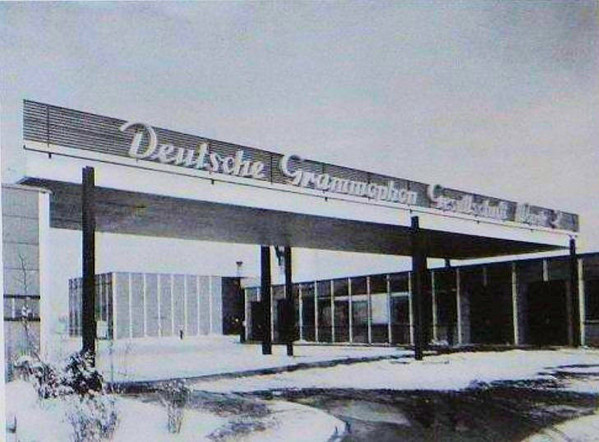
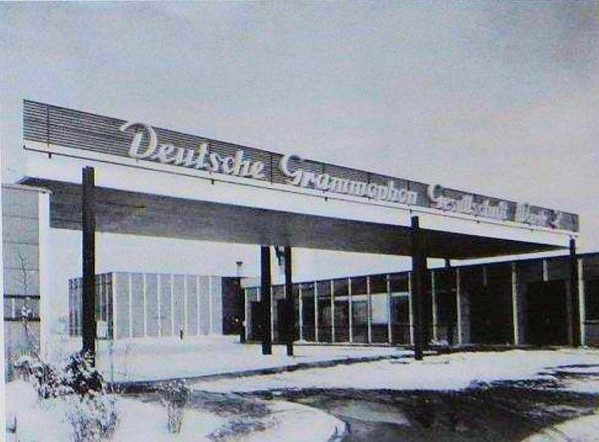
Deutsche Grammophon Gesellschaft Pressing Plant
The vinyl and cassette manufacturing facilities of Deutsche Grammophon GmbH. Only valid for releases between June 1946 and December 1972!
DGG strictly separated the recording and the manufacturing lines, even though located on the same premises:
The plant was responsible for galvanization/plating, pressing and cassette manufacturing for releases from Deutsche Grammophon and Polydor, and all related labels (e.g. Heliodor, Archiv, etc.), as well as for distributed labels (e.g. Coral, MGM, United Artists, A&M, Philips, Mercury, Fontana, etc.)
The Recording Department, later called "Recording Centre", was responsible for all services around recording and mastering (recording, recording techniques and technology, tape mastering and editing, vinyl mastering and cutting) and archiving.
How to identify the plant by runouts:
Shellac and vinyl pressings always have a fully stamped matrix; "stamped" should not be stated in the BAOI description fields.
The stamper codes are tilted 90° to the left (e.g. ◡ for C). They should be added in the runout fields as A, DQ, etc. - without orientation remarks in the runout or description fields.
Mastering/cutting dates:
October 1946 - May 1954:
The mastering date (shellacs) and the lacquer cutting date (vinyl) has four to six digits, e.g. 21.10.52 or 3.3.53 or 13.2.54.
June 1954 - June 1972:
The mastering date (shellacs) and lacquer cutting date (vinyl) can be identified by a letter-number combination, e.g. A7, H71 (often appearing separated, e.g. as B 6).
The letter symbolises the month: A = January, B = February, C = March, D = April, E = May, F = June, G = July, H = August, I or J = September, K = October, L = November, M = December.
The figures indicate the year, e.g. 0= 1960, 1= 1961, 2 = 1962, 3 = 1963, 4 = 1954 or 1964, 5 = 1955 or 1965, 6 = 1956 or 1966, 7 = 1957 or 1967, 8 = 1958 or 1968, 9 = 1959 or 1969, 70 = 1970, 71 = 1971, 72 = 1972.
July 1972: 320 is now used for all releases by DGG, Polydor, Archiv, and sub-labels (note: German Philips releases carry 320 since ca. 1967).
Matrix series:
October 1946 - October 1951:
KK number pair code (e.g. 687 KK or 1192 KK). KK was the sequential matrix series (wartime releases ended with KI), the numbers are recording numbers.
LKK identifies Variable Micrograde 78 releases (between 1949 and 1951 only).
October 1946 - June 1951:
3 to 5 digits on each side for the recording numbers (e.g. 5302/5303).
12" releases (shellac and vinyl) always have a leading zero (e.g. 01253).
Higher numbers (e.g. 10039 or 75636) are either pre-war numbers or taken over from the original recordings (e.g. Brunswick).
Do not add them as LCCN numbers.
July 1951 - February 1958: 5 digits, series 3x.xxx for vinyl LP (10” and 12”) used.
May 1953 - February 1958: 5 digits, series 5x.xxx for vinyl 7”s used.
Do not add them as LCCN numbers.
Recording engineer codes:
January 1951 - December 1957:
“XX(X)” - 2 or 3 letters (e.g. SS or SN or STN or STS or WIS).
The first one or two letters identify the recording engineer, the last letter is believed to stand for the lathe. Used last letters were H, M, N, S, W.
Variable Micrograde 78 is prefixed with L (e.g. LWN, LSTN).
Sometimes the recording engineer is missing and only e.g. S or N appear (i.e. for multiple recordings or compilations).
January 1960 - January 1963:
“x(x) / y(y)” (e.g. D / SL or WO / V). Only in 1960, a middle dot (“·”) can be found, too (e.g. S · SL).
The letters before the slash identify the recording engineer. The letters after the slash are believed to be standing for the lathes. Used letters were S, SL, V, W.
Note: "EL/" was used in this period on releases by DGG Literarisches Archiv. This is not an engineer code.
May 1962 - December 1964:
“x(x) – y(y)” (e.g. D - S or HR - W).
The letters before the dash identify the recording engineer. The letters after the dash are believed to be standing for the lathes. Used letters were K, S, SL, V, W.
October 1964 - December 1967:
“x(xx) ◇ y” (e.g. SCH ◇ H or HE ◇ V).
The letters before the diamond identify the recording engineer. The letter after the diamond is believed to be standing for the lathe. Used letters were H, K, V, W (in January 1965 extended with Z).
January 1968 - June 1972:
“◇ y“ (e.g. ◇ V).
Recording engineers are not prefixing the diamond anymore (exceptionally, a few have still been used in early 1968). The letter after the diamond is believed to be standing for the lathe.
Used letters (and durations): G (February 1970 - June 1972), K (July 1968 - December 1971), V (May 1968 - June 1972), W (January 1968 - August 1970), Z (January 1968 - May 1972), Z1 (September 1971 - May 1972).
January 1969 - June 1972:
“✳ y“ (e.g. ✳ K).
A star is complementing the diamond. The letter after the star is believed to be standing for the lathe.
Used letters (and durations): G (May 1970 - June 1972), K (March 1969 - August 1971), V (July 1969 - May 1970), Z (January 1969 - April 1972), Z1 (February 1972 - April 1972).
Contrac…
Werk I: Podbielskistrasse 164 3000 Hannover 1 Werk II: Klusriede 26 3012 Langenhagen [both obsolete]