

Estudios EMI-Odeon, Barcelona
Spanish studios owned by "The Gramófono-Odeon S.A.E." record label, and after 1970 by "EMI-Odeon S.A." from Barcelona.
Anyway, In March 1931 Gramophone merged with the English Columbia Gramophone Company to form Electric and Musical Industries Ltd (EMI). However, the name "Gramophone Company, Ltd." continued to be used for many decades, particularly for copyright notices on records.
Named The Company, The Gramophone, later credited as (as it became, effectively, the studio of EMI's Odeon label subsequent to it's acquisition - where, for example, the artist Alicia De Larrocha had begun recording in 1932, aged 9, in Barcelona record Label: Odeon in , after published by ).
More variations of the name: Odeon Barcelona, Odeón, EMI studios, Estudios EMI (Barcelona), EMI de Barcelona, Studios EMI Parroco Ubach, Barcelona,
Known for the emblem that represents the dog listening to the sound emitted by the gramophone, and also how the house of the dog.
The public came to refer to the records and the company as “La Voz De Su Amo” due to the prominence of the phrase on the labels; "The Gramophone Company", "CIA del Gramófono-Odeon S.A.E. (after EMI-Odeon)", was never officially incorporated as a company “La Voz De Su Amo.”
Studio locations in Barcelona:
C/ Balmes,1 (at the beginning 1915 until 1929),
C/Provenza, (active between 1929 -1930),
In two places: Ronda Sant Pere, 27 and Av. Tibidabo,18, "Sala Granados" (active between 1930-1940), Record company name is this period: ,
C/ Escorial, 137 near Plaça Sanllehy (active between 1940-1954),
Rambla del Poblenou, 42, (active between 1955-1958), The name of the Record company change to: ,
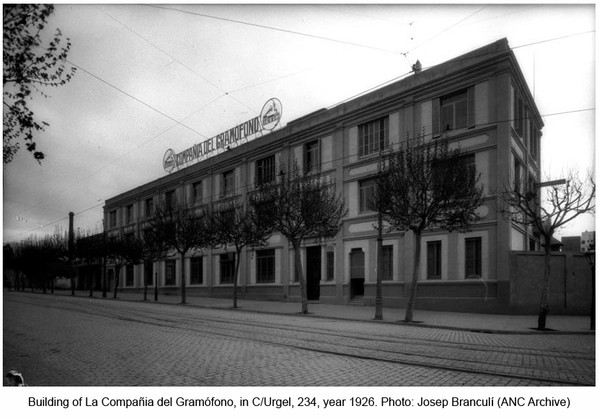
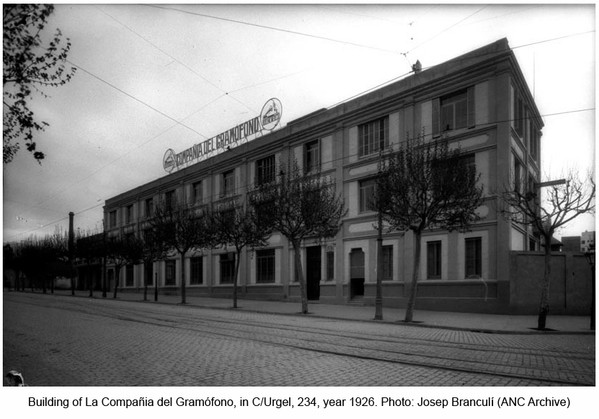
C/Urgell, 234, (active between 1858-1968). Also headquarters of the ,
C/Rector Ubach, 30, (active between 1968-1981). Record company name is this period: .
Record Labels: , , , , , , ,
Musical Direction of Record Company : (Between 1914-1940).
Musical Direction of Record Company : (Between 1940-1963).
Musical Direction of Record Company later : (Between 1963-1981).
Engineers (Between 1914-1932):
Engineers of Record Company "The Gramophone Company": Between (1926-1931), Between (1926-1931), , , J.Jackson, , , .
Chef Engineer of Record Company : Between (1931-1936).
All of them from The Gramophone Company, after , and they worked in diferent periodes in Spain.
Engineers of Record Company , in :
(1945-1958),
(1956-1962),
(1962-1972),
(1962-1965),
(1965-1972),
After change the name of the Record Company around 1970 to: , in :
Chef Engineer (1958-1981)
Also Engineers:
(1962-1972),
(1965-1972),
(1969-1981),
(1971-1976),
(1974-1981),
(1977-1981).
One of the main difficulties in documenting the activity of the Spanish recording industry between 1914 and 1986 lies in the scarcity of technical and artistic information included in many publications of the period. The record company's editorial policy generally did not include detailed credits about the recording process, so many records lack references to the studios where they were recorded, the sound engineers, producers, or other professionals involved in their creation.
The releases compiled on this page constitute a valuable record of carried out by EMI-Odeon Studios in Barcelona as a Branch of EMI-Odeon of London, with the same work policies, for more than five decades. Although the lack of official documentation makes it difficult in many cases to precisely identify the production processes, the analysis of the surviving records, their master tapes, and other sources—both historical and contemporary—allows us to partially reconstruct the activity of studios that played a fundamental role in the history of sound recording in Spain.
"...The Compañía del Gramófono-Odeon (in 1972 it would be renamed EMI-Odeon).
The entire recording process was carried out at the headquarters on Urgell Street, 234, from recording the music to manufacturing the vinyl record and marketing the product. EMI-Odeon already had modern music artists under contract, such as the Dúo Dinámico, the Mustangs, Lone Star, Los Salvajes, Tony Ronald..."
Extract from Book: "ECO I DISTORSIÓ", 2012, Ed, Generalitat de Catalunya, Author: G.Soler garcia de Oteyza. DL: B. 22329-2012 Pages 93-101 complete text.
"...When stereo was introduced in 1958, it came hand in hand with the first British pop bands—Cliff Richard and the Shadows and The Vipers—who were EMI artists recording in EMI studios with EMI producers..."
Ken Townsend, former CEO of EMI-Odeon, in Abbey Road, London (1950-1994)
Extract from Book: "ABBEY ROAD. The Story of The World's Most Famous Recording Studios", 1981, Ed. Omnibus Press. ISBN 978-84-19234-30-8 Pages 242-255 complete text.